
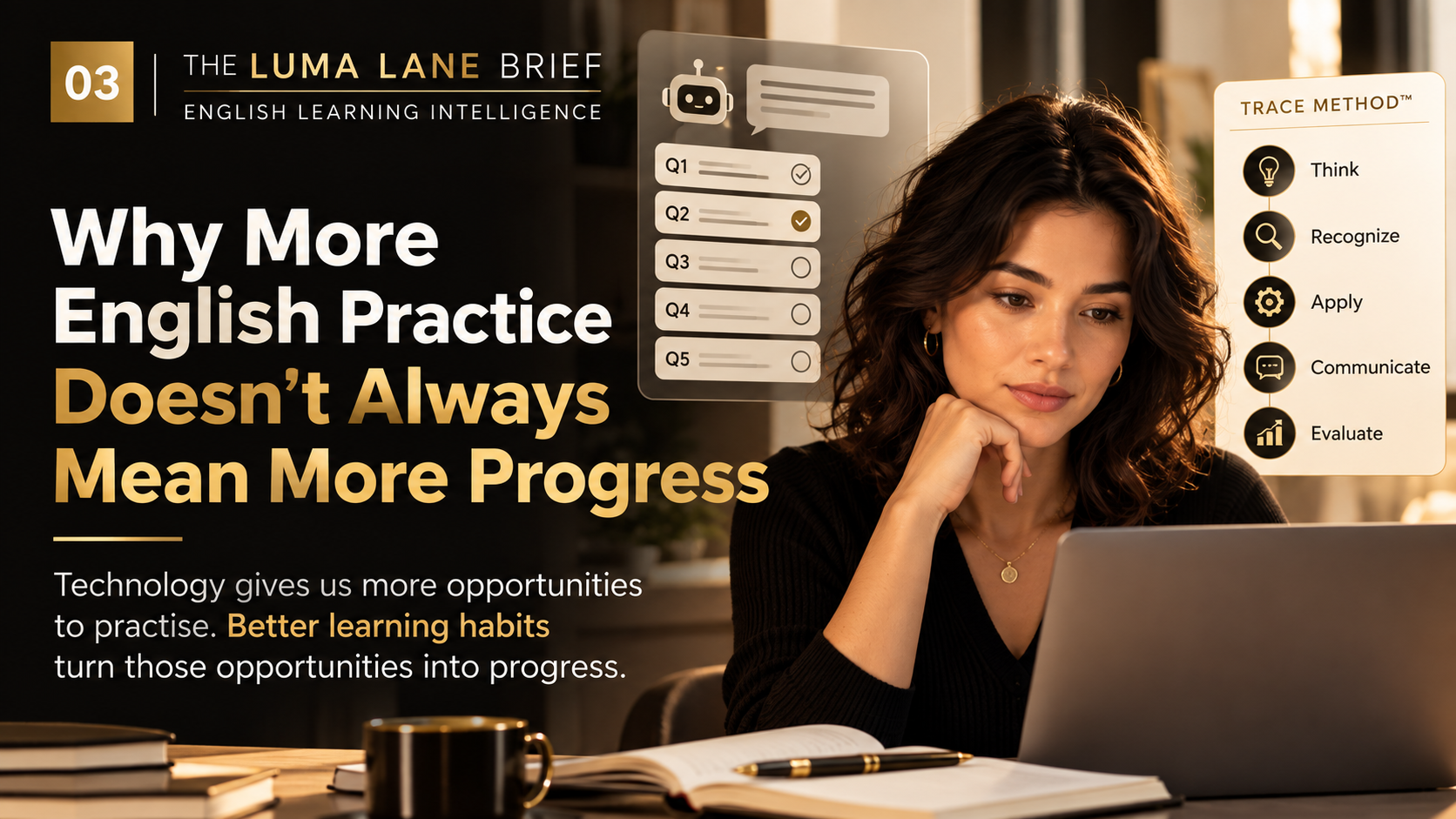
Today, an English learner can open an app and start practicing almost instantly. They can speak with an AI avatar. Answer questions. Simulate conversations. Write responses. Receive corrections. Practice again.
The opportunity is extraordinary.
But there is a problem we don't talk about enough: Technology can multiply practice. It can also multiply poor practice.
When learners rush through activities, ignore feedback and continue using English exactly as they always have, more practice may simply mean repeating the same habits more often.
The real question isn't: How much are you practicing?
It's: What are you learning while you practice?
Core Distinction
Completing an Activity Is Not the Same as Learning
Imagine an AI speaking activity containing five questions. A learner opens it, answers all five as quickly as possible and finishes the activity in a few minutes.
Task completed.
But was there actually a lesson?
Did they understand?
Did the learner understand each question carefully?
Did they think?
Did they think about what they wanted to communicate?
Did they notice?
Did they notice useful language in the question itself?
Did they monitor?
Did they monitor mistakes they already know they tend to make?
Did they examine?
Did they examine the AI's feedback?
Did anything change?
Did anything change between the first response and the last?
If not, the learner may have completed the activity without completing the learning process. That's an important distinction.
The goal isn't to finish the conversation. The goal is to improve something during the conversation.
Perspective
AI Practice Is Not a Playground
Because AI is conversational, immediate and interactive, it can feel informal.
Ask something. Answer something. Click. Continue.
But a well-designed AI practice activity isn't simply something to play with.
It is a lesson.
Every question
can provide vocabulary, sentence structures and clues that help the learner formulate a better response.
Every answer
is an opportunity to apply something learned previously.
Every correction
is information.
Every new attempt
is an opportunity to improve the previous one.
Those opportunities only become learning when the learner pays attention to them.
Warning
The Danger of Autopilot Practice
Language habits are powerful.
Learners often have recurring patterns: missing articles, choosing the wrong tense, constructing sentences in the same inaccurate way, using fillers excessively, or speaking without organizing the message first.
Now imagine giving those habits unlimited opportunities for repetition.
That is where more practice can become counterproductive.
If learners repeatedly produce the same patterns without stopping to notice and correct them, they may be rehearsing the problem instead of changing it.
AI doesn't automatically prevent that.
AI amplifies opportunity.
What the learner does with that opportunity still matters.
Method
Sometimes You Need to Slow Down Before You Can Speed Up
Better practice can initially feel slower. That's okay.
One carefully considered question can be more valuable than ten rushed responses.
Listen & Read
Understand what is being asked.
Think
Think about what you want to communicate.
Build
Build the response one sentence at a time.
Monitor
Before speaking, remember the mistakes you already know you tend to make.
Communicate
Then communicate.
When feedback comes, don't immediately move to the next question.
Look at it.
What changed? What could you say better? What should you carry into your next attempt?
This deliberate process is not designed to make learners permanently slow or hesitant.
It is designed to build better habits until better decisions become increasingly natural.
The TRACE Method™
Better Learning Habits Change Practice
This is one reason Luma Lane uses the TRACE Method™:
THINK
Understand the situation and decide what you want to communicate.
RECOGNIZE
Notice the language, patterns, clues and potential problems.
APPLY
Use what you know deliberately.
COMMUNICATE
Put the language into action.
EVALUATE
Examine the result, learn from the feedback and decide what needs to change next.
TRACE interrupts autopilot. Instead of simply moving from question to question, the learner moves through a learning cycle.
And that distinction matters.
Repetition alone isn't the goal. Better repetition is.
Insight
Five Minutes Can Be Enough
Daily practice doesn't have to mean completing a long list of activities.
Sometimes five focused minutes are enough.
One question.
One thoughtful response.
One opportunity.
To monitor a recurring mistake.
One piece of feedback.
Carefully examined.
One better attempt.
Built on what came before.
Small practice becomes powerful when it is deliberate, consistent and connected to what the learner is trying to improve.
That is very different from completing five activities in a rush just to say they are done.
Conclusion
Technology Is Powerful. Learning Habits Decide What We Do With It.
AI has created possibilities for language learning that were difficult to imagine only a few years ago.
That deserves excitement.
But access to powerful technology doesn't automatically teach someone how to learn.
- Learners still need to think.
- To notice.
- To make decisions.
- To monitor themselves.
- To learn from feedback.
- And to return tomorrow ready to do something slightly better.
Technology can provide the opportunity.
Better learning habits turn that opportunity into progress.
The Takeaway
Don't Practice More. Practice Better.
The next time you open an AI activity, don't ask yourself:
How quickly can I finish this?
Ask:
What am I going to improve in this practice?
Because progress isn't measured by how many questions you answered.
It's measured by what changed between one answer and the next.
Watch and Listen
Watch the Podcast on YouTube
Continue exploring how purposeful practice and stronger learning habits can turn AI-supported practice into real progress.
Watch the Podcast ↗Professional Service
Professional English Consultation
Your English practice should have a purpose.
If you want to understand what may be limiting your communication and what kind of practice could move you forward, request a Professional English Consultation with Luma Lane.
Your responses will be reviewed personally to identify the most appropriate next step for your English.
I'll review your answers personally and recommend the best next step. — Luma Lane